
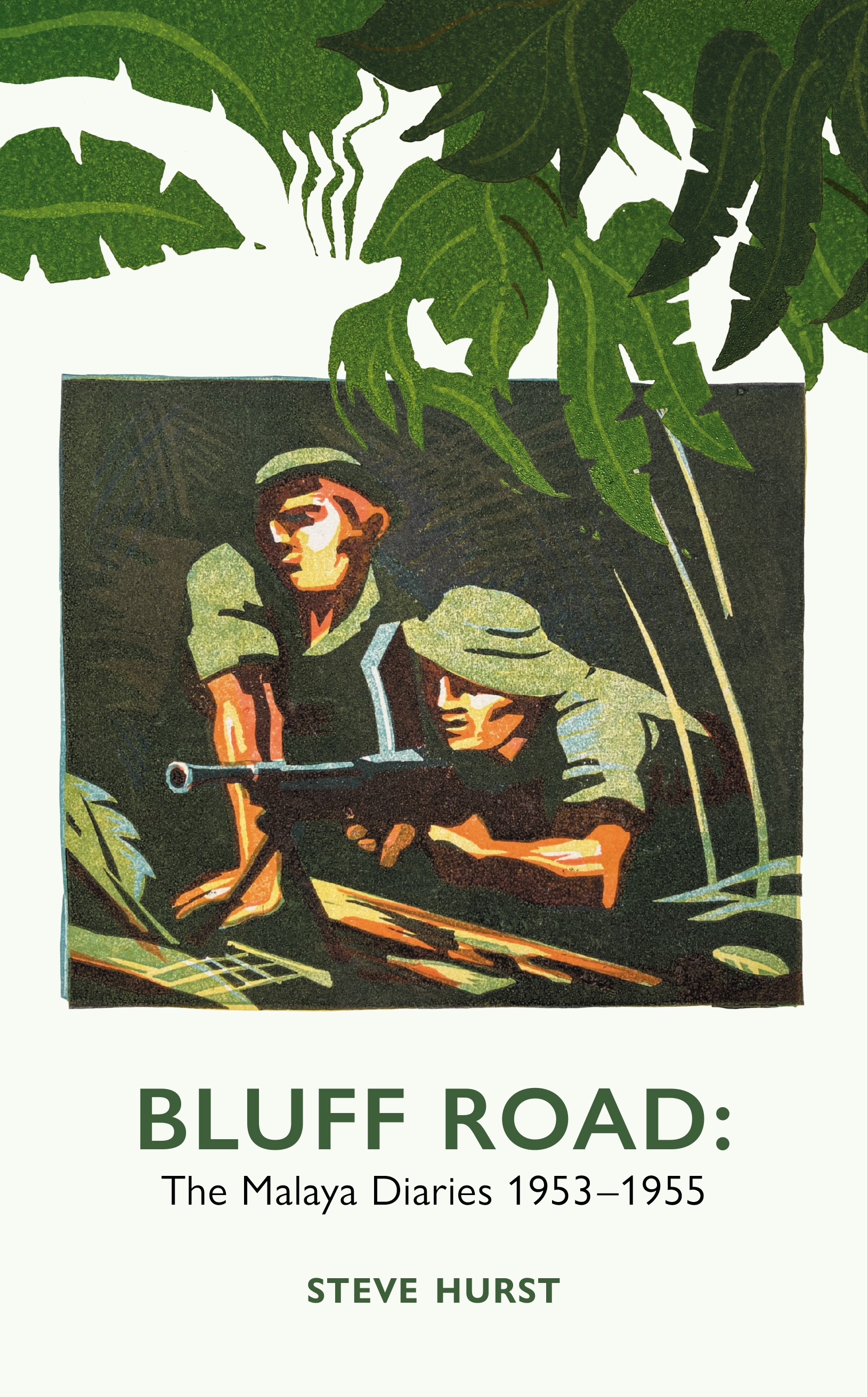
Bluff Road: The Malaya Diaries 1953-1955
by Steve Hurst
To purchase a copy for £20 plus shipping (£4 UK):
For BACS payments contact us directly
July 1953: “I reported to Aldershot still wearing light infantry uniform (unlike my fellow trainees who were given paper and string to send their civilian clothes home)… The only memories of civil life that I carried with me were my sketchbook and rugby boots.”
IN FEBRUARY 1954, 21-year-old Private Steve Hurst left the freezing British winter and set sail for Malaya, then in the midst of the ‘Emergency’ – a war in everything but name. Almost completely ignorant of the roots of the conflict, just months previously Hurst had been a student at Oxford’s Ruskin School of Drawing & Fine Art.
Half a world away from the quiet focus of the art school or his village life in the Thames Valley, Hurst found Malaya to be all tropical heat and monsoon, jungle and the Neo-Saracenic architecture of the still undeveloped Kuala Lumpur; a whirl of multicultures, sometimes clashing.
Working in the Map Room at the Intelligence HQ on Bluff Road, Hurst’s skills as a draftsman were utilized to physically plot the ebb and flow of the fighting, updating maps and tracing the movement and bloodshed of the war; out of the combat zone but privy to the brutalities of a struggle that was as much an ideological civil war as an imperial venture. Here he developed a deep appreciation for the bravery of the infantrymen serving in the jungle, as well as a sympathy for the Malayans caught in the crossfire of the opposing forces.
Hurst was a conscript but had volunteered for overseas service. Like all his generation, he had grown up in the shadow of war and for his generation it seemed inevitable that he would serve in the military at some point – and this at a time when yet another globally catastrophic war seemed a more than distant possibility. In the army Hurst sought (and found) traces of the Empire soldiery Kipling had written about. Before he sailed, Malaya held for him traces of the romances of Conrad and Somerset Maugham. However, and inevitably, the reality was uglier and more chaotic.
Paradoxically, while released from the social structures of Oxford and England, Hurst also found a personal sense of freedom, even within the confines of service life, exploring the jungle surrounding Kuala Lumpur and enjoying its occasionally Rabelaisian nightlife. However, a combination of youthful optimism and ignorance led to a potentially fatal jaunt into the turmoil of Cambodia following the collapse of French Indochina and as violence flared across Southeast Asia.
Journals were forbidden on active service, but the young artist-soldier kept both diary and sketchbooks close at hand, observing and capturing his surroundings with a painter’s eye. Over 70 years later, Bluff Road has emerged, a personal history and a valuable record of an often-overlooked period in the early Cold War-period.
Buy now for £20 (plus postage):
PayPal | For BACS payments contact us directly | Blackwell’s | Waterstones
Click here to find out more about the author Steve Hurst.
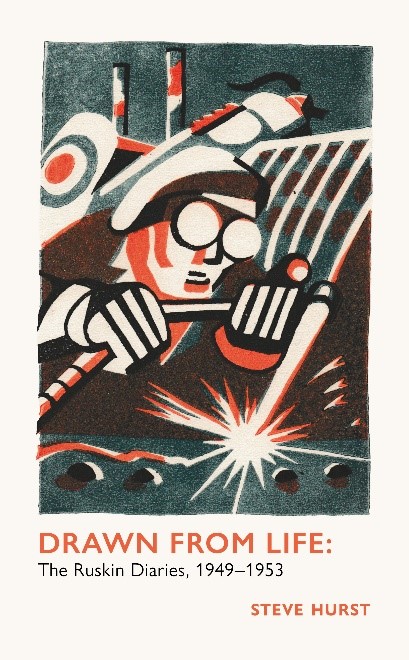
Drawn From Life: The Ruskin Diaries, 1949-53
by Steve Hurst
Drawn From Life was published in 2022. Read more about the book.
To purchase a copy for £15 plus shipping (£3.20 UK):
PayPal (£18.20 if posted in UK)
For BACS payments contact us directly
“Drawing is a means of seeing,” wrote John Ruskin, and in 1871 this most eminent of Victorians established his School of Drawing at the University of Oxford and housed it in the world’s oldest university museum, the Ashmolean. In October 1949, the young Steve Hurst first pushed his way through its grand entrance doors and began his formal education as an artist.
Based on his diaries, Drawn From Life is Hurst’s account of his time studying at the Ruskin and illustrates how much the world – and not only of art – has changed since the days immediately after the Second World War. As he began learning the rudiments of drawing in the dark, wintry cast galleries of the Ashmolean in the days before the museum was open to the general public, he was also working against the backdrop of a soot-blackened Oxford in an austerity Britain which could be forgiven for wondering if it had truly won the war. Rationing was still in place, the physical scars of conflict were still evident in all the cities, and in many people, and, further afield, the empire was crumbling. Glimmers of approaching social change were evident under a socialist government after the ‘khaki election’ of 1945, but optimism was in short supply.
At a university still containing many older students who had served in (and in some cases been damaged by) the war, Hurst was also straddling different worlds as he attempted to balance life as a village lad from Sandford on Thames on the edge of Oxford with that of a fledgling artist at the Ruskin, at that time an eccentric atelier-style art school, both part of and discrete from its own university, Hurst’s arrival also coincided with that of a new Master, Percy Horton, who was attempting to shed the School’s reputation as a haven for dilettantes.
As Hurst found himself on the literal margins of both Town and Gown, the young man also had to cope with a splintered home life. With his father based in Cairo and his mother suffering a breakdown and spending time in the local Warneford Hospital, he was left to manage as best he could. Also, looming ahead of him was national service at a time when British troops were still actively engaged in Korea, Malaya and the Middle East.
At this time an art education was not notably formal, but during this period Hurst encountered many guest lecturers who included some of the most notable British artists of the period, including John Piper, Laura Knight, Enid Marx, the tragic John Minton, and Evelyn Dunbar. Hurst was combining art lessons in the Life Room with life lessons working on local building sites, rubbing shoulders with both the jeuness d’oree of the University and the working folk of Oxford.
Drawn From Life captures the fascination and frustration of craft and creation, and the will to achieve the capacity to grasp the elements that enable a young artist to forge a life in art. The book is both a personal and social history; a pen portrait of a world in flux, which aims to “glue a few missing pages into the immense book of art history.” In essence, this book tracks the development of a young artist learning to make sense of a the bruised world around him, and, literally, learning to see.
HB, 354pp, 2022
Click here to find out more about the author Steve Hurst.
 WarmPorch Publishing